Chocolate!
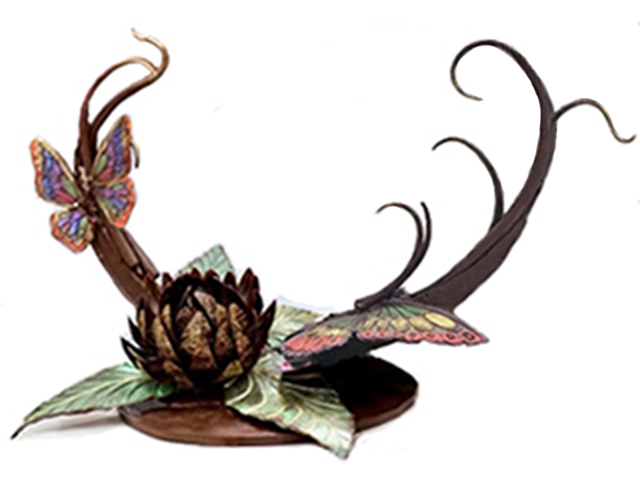
chocolate sculpture
Chocolate Showpieces
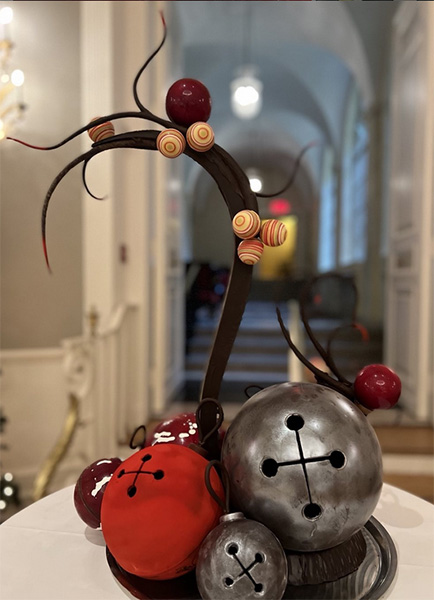
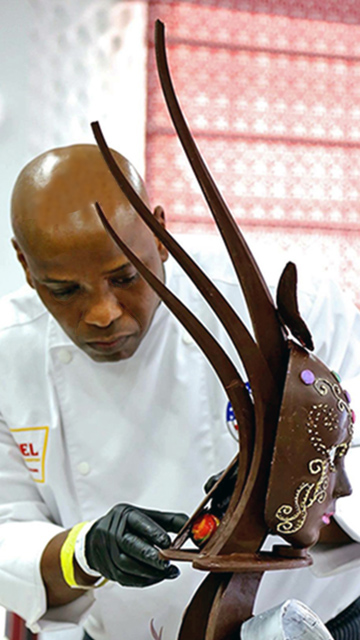
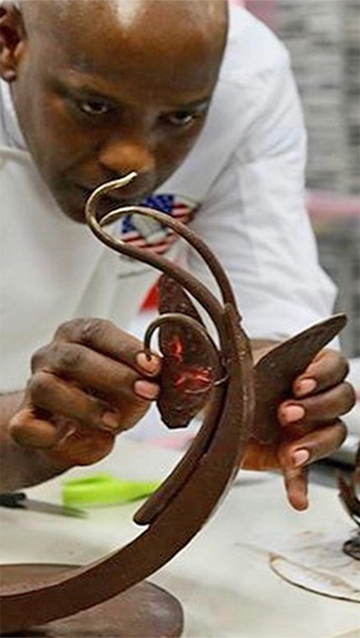
Unlike his competition showpieces which have equal parts of chocolate and sugar, Chef Smith’s chocolate sculptures are almost 100% chocolate based. He designs, carves, molds and builds these spectacular works for special events and holiday displays at The Private Social Club, where he is Executive Pastry Chef.
CHOCOLATE SCULPTURE
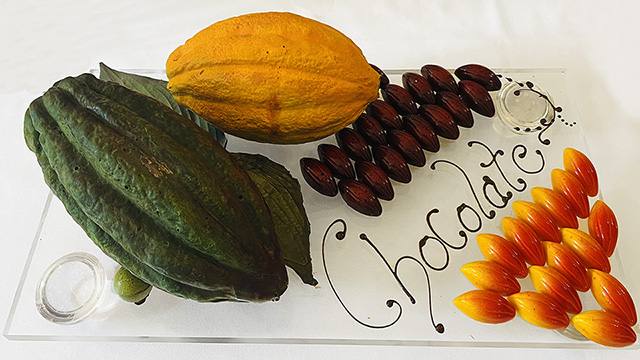
The Chocolate Garden
Visit the Chocolate Garden to view Chef Smith’s realistic and abstract renditions of fruit, flowers and foliage.
His cocoa pod chocolate sculptures are amazing in their lifelike appearance and texture. They will definitely make you look twice!
Chocolate Event!
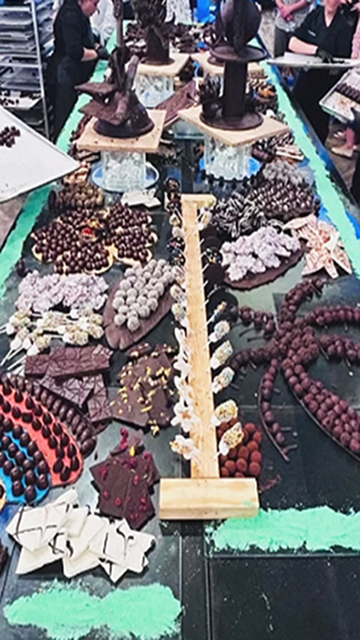
For an event in 2024, Chef Smith created multiple chocolate sculptures
and arranged a 50 foot chocolate banquet with 75 different varieties of chocolate that served 2,000 guests!
Chocolate Tempering 101
by Pastry Chef Instructor Anthony Smith
(Tried & True Old Fashioned Method)
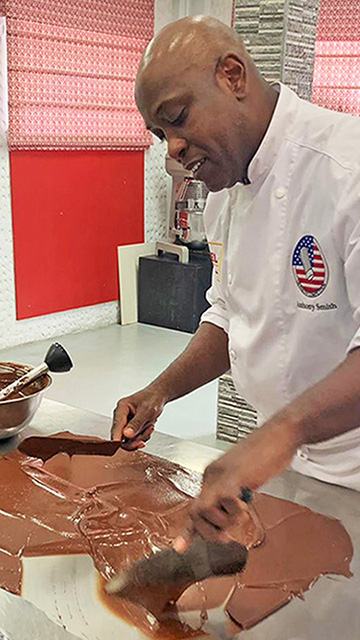
These are the three essential things to tempering chocolate we have to remember: time, temperature and movement.
You need it at the right temperature, you need movement to stir it up to create good crystals in order for it to start tempering and of course, time – we need time to do everything, so it has to have the right amount of time. You don’t want to take too long or do it too quickly because it won’t be tempered.
Chocolate is made up of a number of fats. What you want to do is melt those fats and make sure that they all melt. If you don’t raise the temperature high enough, only some of the fats will be melted. Some won’t. It’s easy to get tricked.
So what if, the chocolate melted at a hundred degrees, but not all the fats have broken down? So what happens is, when your chocolate solidifies again, it’s not going to be the same. It’s not going to have the same texture. It’s not going to have the same mouthfeel as it did when fully tempered.
Tempering Dark Chocolate
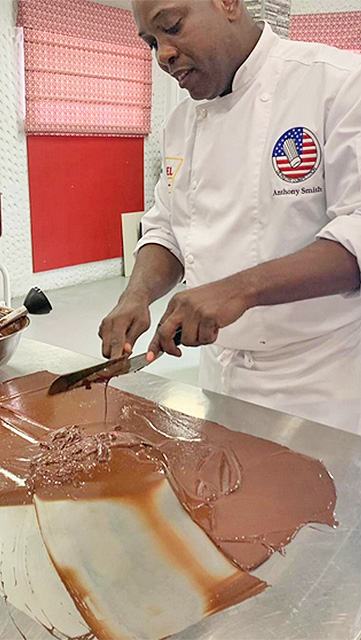
What you want to do is work with a bowl, some container to put your chocolate pastilles into. A lot of times we use a microwave to do this heating up and down.
Now you want to bring that chocolate – if you’re working with dark chocolate, somewhere between 112 and 122 degrees Fahrenheit. You want to heat it up. Chocolate is made up of a number of fats.
At 122 degrees you’re sure all these fats have melted.
So you want to heat your chocolate up 112 to 122 degrees then you want to bring it down to around 85 to 88 degrees. So you go from really hot to really cold and you want to do this rather quickly. A lot of times we do this by seeding. So, you add some of your chocolate that’s still in solid form, back into your melted chocolate. Bring that down to about 88, 85 degrees.
Bring it to working temperature. – for a lot of dark chocolate this is anywhere between 89 and about 92 degrees depending on the brand.
Tempering chocolate is a little tricky, you want to be careful. Even If the working temperature is correct, it does not mean it was tempered correctly.
For chocolate to be fully-tempered, fat must be melted, dispersed and realigned . At the right time, the right temperature, using the right motion.
This will give you the best results as far as snap when you break it, shine and mouthfeel.
If not, your chocolate will look like it’s ready and that it’s working, but it’s really not right.
Tempering White Chocolate
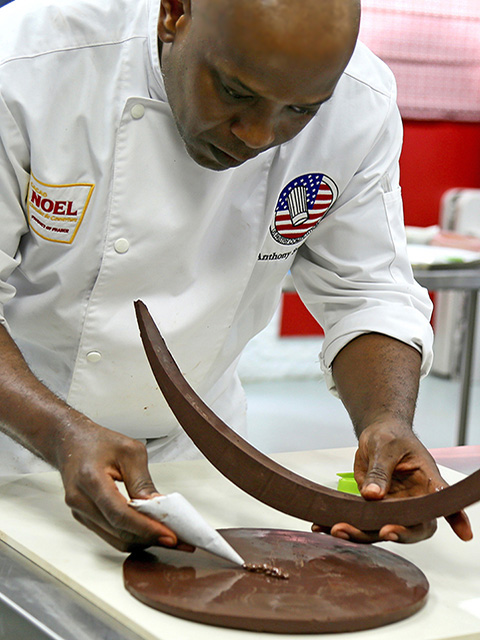
White chocolate is a little more sensitive. It does not contain any cocoa mass, which is why it’s white. It simply contains cocoa butter and certain additives and flavors. There is Lecithin, which helps with the structure and the longevity of the end product. You have things like vanilla, milk powder, sugar.
So because there’s no cocoa mass it isn’t as strong. Especially when you’re building a big chocolate sculpture. You don’t want to use white chocolate, because it’s softer, you want to use a darker chocolate with a higher percentage of cocoa in it.
White chocolate is the most sensitive of all the chocolates because of the lack of cocoa mass in it, so in using it you want to go through the same exact motions that you did for tempering dark chocolate, but you don’t heat it up as high because it’s a little more sensitive.
So you want to heat up white chocolate to around 112, 115. Don’t let it pass 120. You want to bring it down to about 85 degrees once again, and you want to work with it somewhere between 89 and about 91 degrees, that’s the ideal working temperature.
But you go through the same motions. It’s the same technique as in tempering dark chocolate.
Tempering Milk Chocolate
When you speak of milk chocolate, it’s in between dark chocolate and white chocolate. It does have cocoa mass, but not as much as the dark chocolate. And of course, white chocolate has none, so milk chocolate has some.
You heat that up to somewhere between 115 and about 120, max.
You bring that down to between 85 and 90.
Then you heat it back up to work – somewhere between 89 and 91 degrees. That’s your ideal working temperature for milk chocolate.
Watch the video for the full transcript